
clinical · first-line · application-prep
Why medical cannabis is not a first-line treatment — and what that means for your application
Last reviewed · Reviewed by Dr. Medical Director — Docto24 panel
Cannabinoid therapy is rarely the first answer for any indication. Understanding why — and what "trialled first-line" actually requires — is the difference between an accepted Section 21 application and a declined one.
Patients sometimes come to Docto24 expecting that any indication on our conditions list automatically qualifies for a Section 21 cannabinoid prescription. That is not how the pathway works — and the gap between expectation and reality is the single most common reason for SAHPRA declines.
What "first-line" actually means
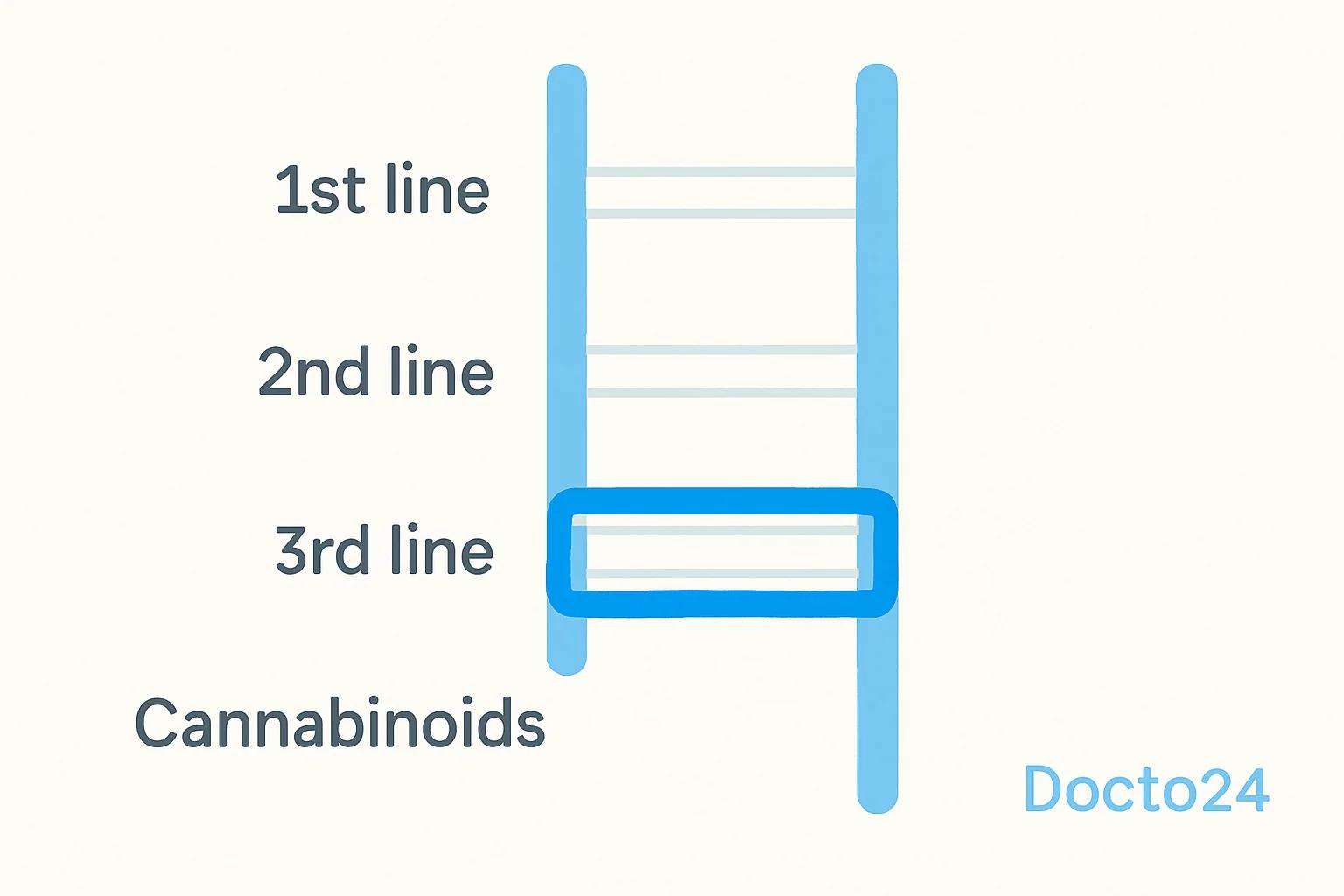
For each medical condition, evidence-based clinical guidelines specify a sequence of treatments. **First-line** therapy is the option with the strongest evidence base, the most favourable side-effect profile, and the lowest barrier to access. **Second-line** is what gets tried when first-line fails or is poorly tolerated. **Third-line** is for refractory or specialist cases.
For chronic pain, first-line is paracetamol, NSAIDs, physiotherapy, structured pain-management. For insomnia, first-line is cognitive behavioural therapy for insomnia (CBT-I) plus sleep hygiene. For anxiety, first-line is SSRIs and psychological therapy. For epilepsy, first-line is conventional anti-seizure medications. **Cannabinoids are not first-line for any of these.**
The pathway expects that conventional options have been worked through with documented response and reasons for discontinuation before cannabinoids are considered as adjunct or alternative.
What documentation strong applications include
**A diagnosis** — confirmed by a clinician, ICD-11-coded, with the diagnostic basis (specialist letter, imaging, EEG, sleep study, etc. as appropriate to the indication).
**Treatment history** — what conventional medications have been tried, at what doses, for how long, with what response, and why discontinued (lack of efficacy, intolerable side effects, contraindication). "I tried it but it did not work" is weaker than "I tried 600mg gabapentin three times daily for 8 weeks with 20% pain reduction and intolerable somnolence".
**Current treatment context** — what you are currently on, whether you are stable, whether your specialist is involved.
**A specific clinical question** — what symptom is being targeted with cannabinoid therapy and how response will be measured.
Why this gate exists
Two reasons. First, cannabinoids genuinely are not first-line — for most indications the evidence base is moderate-to-weak compared to established therapies. Skipping conventional options means risking poor outcomes for patients who would have responded to standard care. Second, SAHPRA reviews applications against an expectation that the regulatory pathway is reserved for patients who genuinely need the unregistered-medicines route. Applications that look like attempts to skip first-line therapy face declines.
A doctor who accepts your case but cannot defend the first-line trial documentation in the SAHPRA application is not helping you — they are setting up a decline that costs you time and the SAHPRA fee.
What this means for your assessment
Be honest in the intake about what you have actually tried. Bring whatever documentation you have. If first-line has not been adequately trialled, the doctor may defer cannabinoid prescribing and recommend that pathway first — that is good clinical practice, not gatekeeping. Coming back after a documented first-line trial gives you a much stronger application than pushing for cannabinoid access without it.
Glossary terms in this article
Related conditions
Researching whether the Section 21 cannabis pathway is right for you? The eligibility assessment takes around five minutes.
START ELIGIBILITY ASSESSMENT